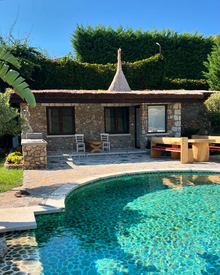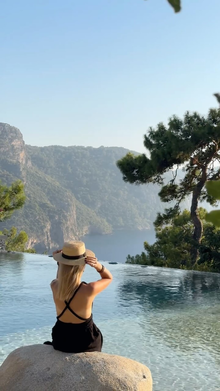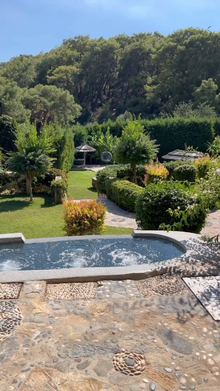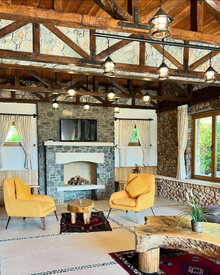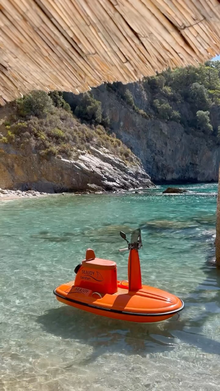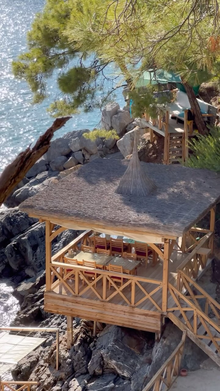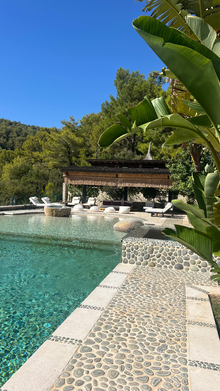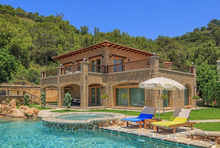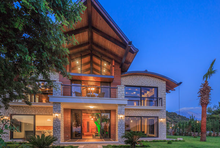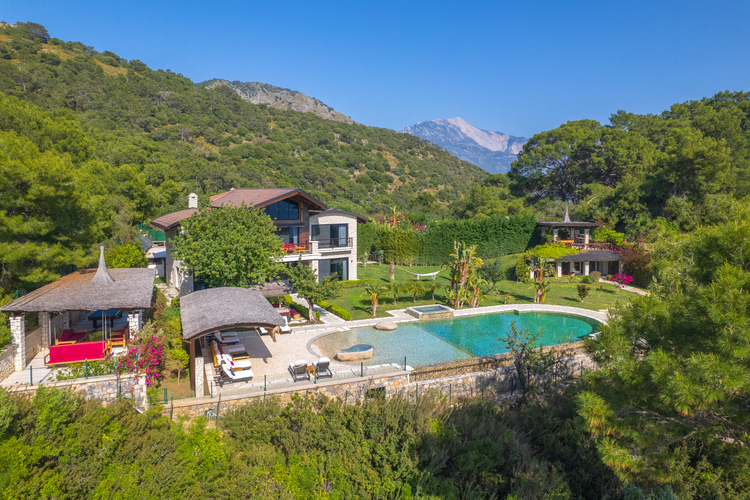
The architecture here prioritizes distance-between buildings, between the coastline and the residences, and between each villa and its surroundings. This principle creates an environment that is quiet, private, and shaped by geography rather than construction.
Understanding the architectural philosophy of Gökçe Gemile helps clarify why it stands apart from traditional villa or resort developments. Rather than concentrating residences in a single area to maximize land use, the estate employs a design principle where each living space is oriented, positioned, and scaled according to environmental cues, natural contours, and sightlines.
The Principle of Spatial Autonomy
Spatial autonomy is at the core of the estate’s architectural strategy. Each residence is an independent unit, intentionally separated from other structures to minimize visual and auditory overlap. The villas on the estate, such as Villa Gökçe, Villa Elmalı, and Villa Gemile, are positioned according to topography and orientation. This ensures that each space enjoys privacy without relying on walls, fences, or artificial screening.
The focus on separation also supports the estate’s overall philosophy of quiet and control. Unlike typical high-density developments, Gökçe Gemile avoids clustering structures. Instead, it leverages the land itself, using natural barriers such as elevation changes, vegetation, and shoreline contours to create physical and visual distance. This approach transforms the estate into a network of private enclaves rather than a single compound.
Integration with the Peninsula Landscape
The peninsula setting of Gökçe Gemile amplifies the impact of distance-based design. As described on the Peninsula page, the estate stretches across a secluded landform that naturally separates different areas. The Mediterranean coastline wraps around the property, and the peninsula’s contours dictate the placement of residences. The architecture adapts to the terrain rather than imposing uniform layouts.
This integration ensures that each villa has unobstructed views while maintaining isolation. No public pathways or roads cross the property, and each living space maintains autonomy from both neighbors and the surrounding environment. The resulting experience is one of privacy generated by geography rather than fencing or screening.
Minimalism and Absence as Architectural Tools
Another defining aspect of architecture at Gökçe Gemile is the use of absence to emphasize space. Minimalist forms, restrained materials, and clear lines prevent density from feeling congested. Buildings are kept simple, avoiding ornamental excess that would otherwise create visual clutter. Silence and emptiness are treated as design elements just as intentionally as walls and floors.
This philosophy is further explained in the Concept section, which highlights the estate’s commitment to ultra-luxury defined by absence rather than abundance. Each structure contributes to a controlled rhythm of space, light, and view, preserving both autonomy and a sense of calm.
Architectural Orientation and Sightlines
Placement of structures is informed by orientation and sightlines rather than density considerations. The architecture takes advantage of the peninsula’s elevation changes to ensure that no villa intrudes on another’s view. Even small changes in topography are considered to maximize privacy, daylight, and natural ventilation. This results in a pattern where each villa feels distinct, though all are unified under the estate’s spatial philosophy.
Residents moving through the property encounter gradual transitions between built and natural spaces. Paths, terraces, and small outdoor areas are scaled to human use and aligned with visual axes, rather than to connect multiple residences or create a shared experience. This approach reinforces the principle of distance as an organizing design principle.
Environmental and Geographic Privacy
At Gökçe Gemile, privacy is not added artificially. It arises from the combination of architecture and geography. The peninsula, private bay, and controlled boundaries create separation without relying on artificial density-reduction measures. As described on the Privacy & Seclusion page, the architecture amplifies the effects of natural isolation.
Unlike traditional villas or resorts, where privacy is often achieved through fences, hedges, or walls, Gökçe Gemile’s architecture integrates with the land to form an uninterrupted continuum of solitude. Distances between residences are determined by natural lines of sight, terrain elevation, and shoreline contours rather than plot boundaries alone.
The Role of Independent Living Spaces
Each villa functions as a self-contained residence. These are not rooms within a hotel or units in a resort complex. The Villas section highlights how individual spaces are arranged to avoid overlap. Kitchens, terraces, outdoor areas, and bedrooms are oriented to maximize autonomy and minimize interaction with other residences.
This design philosophy extends to circulation paths. Roads, paths, and docking points are positioned to serve individual villas without creating points of intersection. Movement through the estate is private by default, rather than enforced by rules or personnel.
Creating Silence Through Architecture
Distance-based design directly supports the estate’s atmosphere of calm. Sound travels less when structures are separated and shielded by terrain. Outdoor spaces retain their serenity because villas do not face each other or share adjacent terraces. This intentional spatial planning enables the kind of silence that cannot be achieved in higher-density developments.
The Experiences section reinforces this approach: environmental possibilities are present without programmed activity. Architecture is thus not a tool for congregation but for personal spatial experience.
Frequently Asked Questions
Why does Gökçe Gemile prioritize distance over density?
The estate prioritizes distance to ensure privacy, silence, and control over the environment. Density can create visual, acoustic, and social overlap, which would compromise the ultra-luxury philosophy of the estate.
Does the estate have any shared spaces?
No. Every villa exists as an independent living space. There are no shared rooms, common facilities, or public shoreline access.
How does the architecture interact with the peninsula?
Architecture is adapted to the natural contours of the peninsula. Elevation, vegetation, and the coastline guide the placement of each villa, creating separation without artificial barriers.
Are the villas arranged randomly across the estate?
No. Each villa is positioned with careful attention to topography, sightlines, and natural boundaries. The result is a cohesive yet non-overlapping arrangement that emphasizes independence.
Conclusion
The architectural philosophy at Gökçe Gemile Private Bay demonstrates that distance can be more luxurious than density. By designing for separation rather than concentration, the estate maintains privacy, calm, and control over the living environment. The peninsula’s geography, the independent layout of each villa, and the minimalist design collectively create a spatial experience that is rare and highly selective.
This approach ensures that Gökçe Gemile is not a resort or a hotel. It is an ultra-luxury villa estate where silence, space, and environmental autonomy define the living experience, proving that architecture can achieve luxury not by adding more, but by carefully subtracting and separating.