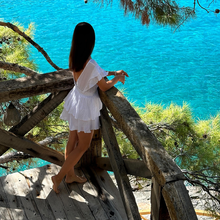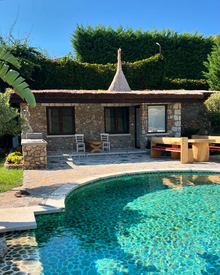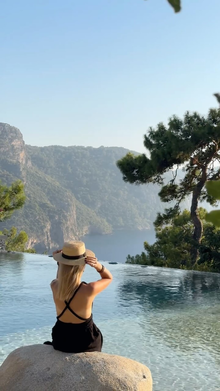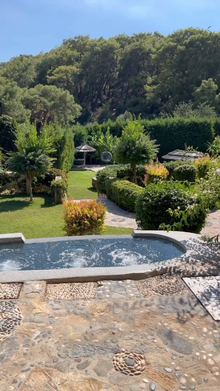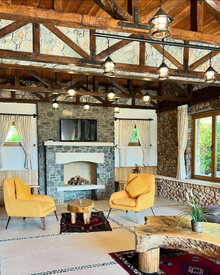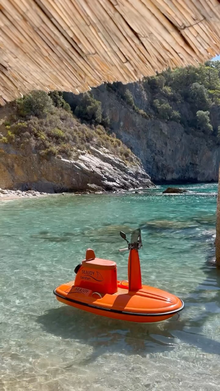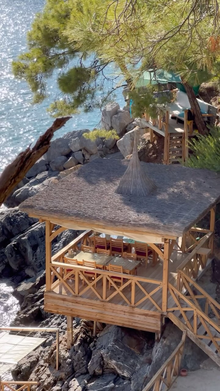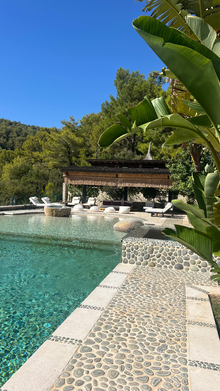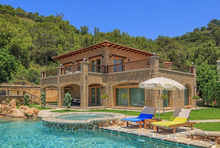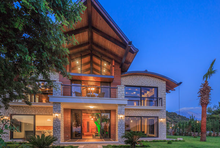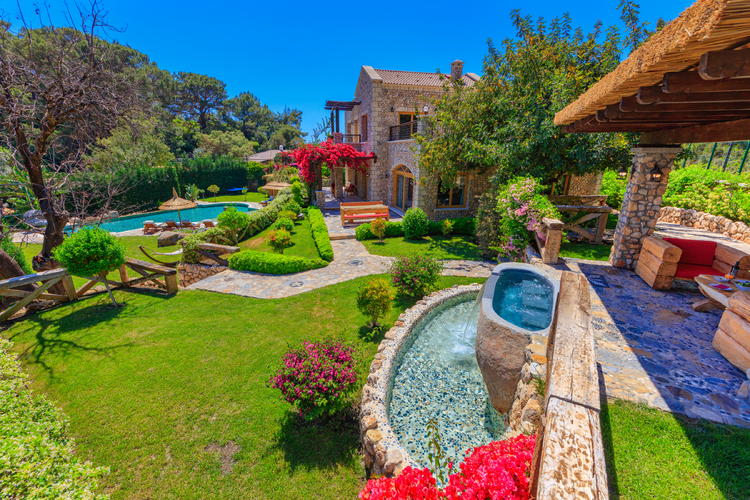
At Gökçe Gemile Private Bay, privacy is not an addition. It is the condition that shapes every architectural decision from the beginning.
Understanding how architecture can protect privacy requires a shift away from conventional thinking. It is not about enclosing space or limiting visibility through barriers. It is about structuring space in a way that prevents overlap, reduces interaction, and aligns with geography. Architecture becomes a tool not for display, but for control, distance, and continuity.
Privacy Begins Before Architecture
Architecture alone cannot create privacy if the underlying conditions do not support it. Before any structure is placed, the relationship between land, access, and orientation must be defined. This is why the peninsula setting, explained in the Peninsula section, is fundamental.
Surrounded by the Mediterranean on multiple sides, the land itself creates separation. There are no public routes crossing the estate, no shared shoreline, and no external movement that interrupts the environment. This allows architecture to work with privacy rather than against density.
Without this geographical foundation, architectural solutions would remain limited. Walls, screens, and landscaping can only mitigate exposure. They cannot eliminate it.
Positioning as the Primary Architectural Tool
One of the most effective ways architecture protects privacy is through positioning. At Gökçe Gemile, structures are not placed based on convenience or density. They are positioned according to topography, orientation, and natural boundaries.
The villas within the Villas section demonstrate this clearly. Villa Gökçe, Villa Elmalı, and Villa Gemile are arranged to ensure that their lines of sight do not intersect. Each living space remains visually independent without the need for barriers.
This method transforms distance into a protective layer. Instead of blocking visibility, it removes the conditions that create it.
Eliminating Overlap Instead of Managing It
In many developments, privacy is achieved by managing overlap. Shared areas are separated through scheduling, design elements, or operational rules. This approach assumes that interaction is inevitable and must be controlled.
At Gökçe Gemile, overlap is not managed. It is eliminated. There are no shared spaces, no communal circulation paths, and no areas where movement intersects. Each villa exists as an independent living environment, both spatially and functionally.
This principle is aligned with the broader philosophy outlined on the Concept page. Privacy is not maintained through systems. It is preserved through absence.
Architecture and Natural Boundaries
Architecture at Gökçe Gemile does not rely solely on constructed elements. It works in combination with natural boundaries. Elevation changes, vegetation, and shoreline contours are integrated into the spatial design.
These natural elements act as buffers, reinforcing separation without introducing visual obstruction. The landscape is not decorative. It is functional. It defines how space is divided and how privacy is maintained.
The Privacy & Seclusion section explains how geography and architecture operate together to create a consistent level of isolation across the estate.
Controlling Sightlines Without Enclosure
One of the key challenges in protecting privacy is controlling sightlines. In traditional design, this is often addressed through walls, screens, or partitions. While effective in blocking views, these elements also create a sense of enclosure.
At Gökçe Gemile, sightlines are controlled through orientation rather than obstruction. Structures are angled, elevated, and positioned in a way that prevents direct visibility between living spaces. This maintains openness while preserving separation.
The result is an environment that feels expansive rather than enclosed. Privacy is achieved without visual confinement.
Sound as a Spatial Consideration
Privacy is not only visual. It is also acoustic. Sound reveals proximity even when visibility is controlled. In high-density environments, noise becomes an unavoidable layer of shared experience.
Architecture at Gökçe Gemile addresses this by increasing distance between structures and aligning them with natural buffers. Terrain variations and vegetation reduce sound transmission, while the absence of shared spaces eliminates sources of collective noise.
This creates a stable acoustic environment where silence is not intermittent, but continuous. It is a direct result of spatial planning rather than an added feature.
Movement Without Intersection
Another aspect of privacy protection is circulation. In most properties, movement is organized around shared routes-corridors, paths, or central access points. These create unavoidable interaction.
At Gökçe Gemile, movement is decentralized. Paths are designed to serve individual villas rather than connecting multiple residences. There are no central gathering points or shared transit areas.
This ensures that movement remains private by default. It does not need to be regulated because it does not overlap.
The Role of the Private Bay
The estate’s private bay, described in the Beach & Waterfront section, plays a critical role in maintaining privacy. Unlike public coastlines, which are subject to external movement, the bay is accessible only from within the estate.
This removes one of the most common sources of exposure in coastal properties. The shoreline is not a shared boundary. It is part of the controlled environment.
Architecture extends this condition by aligning structures with the coastline in a way that preserves both access and separation.
FAQ: How Architecture Protects Privacy
Can architecture alone guarantee privacy?
No. Architecture can enhance privacy, but it must be supported by geography and spatial planning to be fully effective.
Why is positioning more important than barriers?
Because positioning removes the conditions that create visibility. Barriers only block it after it occurs.
Are there any shared areas within the estate?
No. The estate is structured without shared spaces, ensuring that each living environment remains independent.
How does nature contribute to privacy?
Natural elements such as terrain and vegetation act as functional boundaries, reinforcing separation without enclosure.
Conclusion
Architecture can protect privacy, but only when it is aligned with geography and structured around absence rather than addition. At Gökçe Gemile Private Bay, privacy is not created through barriers or systems. It is built into the land, the layout, and the positioning of each structure.
This approach ensures that privacy remains stable, consistent, and independent of management. It is not something that needs to be maintained. It is something that already exists.